 Spain, 2026 world champions
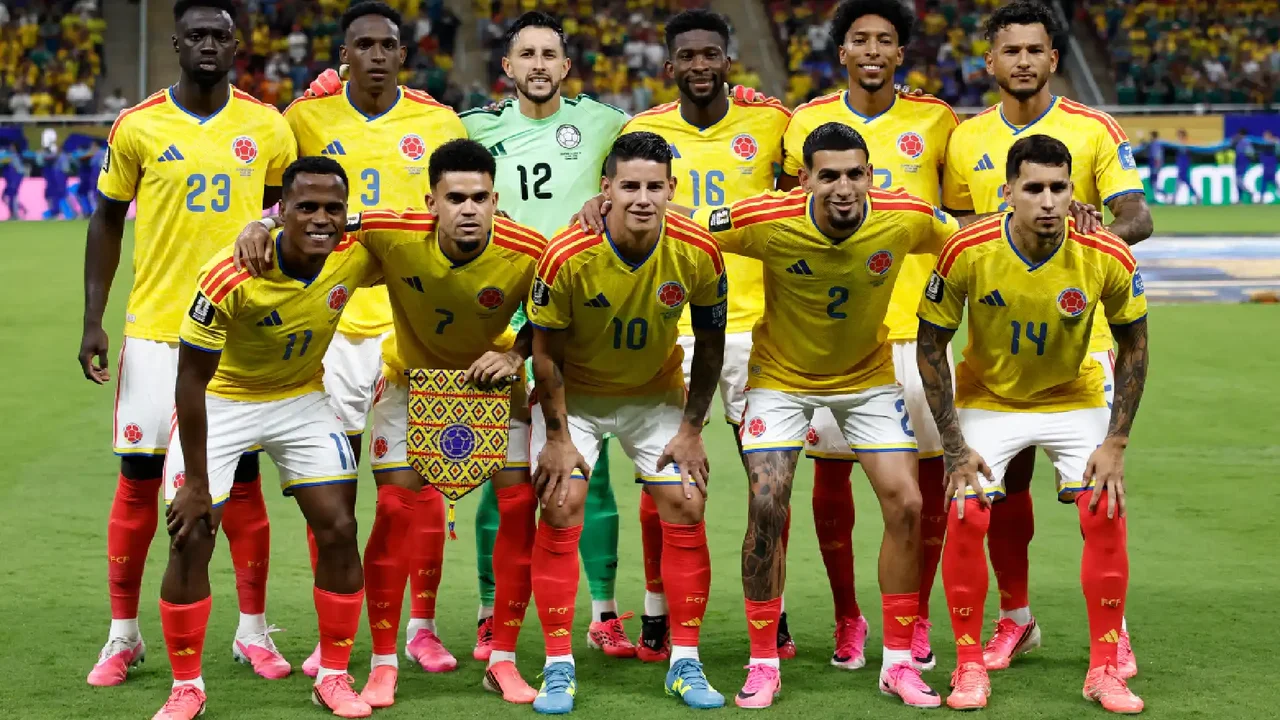
On May 25, 2026, Néstor Lorenzo gathered the media to announce the 26 players who will wear the Colombia shirt at the FIFA World Cup 2026. It is the first World Cup the Colombian team has reached since Russia 2018, eight years later, and the first World Cup Lorenzo directs as head coach.
The list has James Rodríguez as captain, Luis Díaz as the player at the highest current level and Falcao as the most painful absence. This guide explains everything: who the 26 are, the condition of the key players, why Falcao was left out and what to expect from Group K.
Colombia's 26 call-ups for the 2026 World Cup: full list
The squad was announced on May 25, 2026. On May 15, Lorenzo had published a 55-man provisional list that already hinted at the most important names. Going from 55 to 26 meant much-discussed exclusions, the most notable being Rafael Santos Borré, whom Lorenzo left out due to the better form of the other forwards called up.
| Pos. | Player | Club |
|---|---|---|
| GK | Camilo Vargas | Atlas (Mexico) |
| GK | Álvaro Montero | Vélez Sarsfield (Argentina) |
| GK | David Ospina | Atlético Nacional (Colombia) |
| DF | Dávinson Sánchez | Galatasaray (Turkey) |
| DF | Jhon Lucumí | Bologna (Italy) |
| DF | Yerry Mina | Cagliari (Italy) |
| DF | Willer Ditta | Cruz Azul (Mexico) |
| DF | Daniel Muñoz | Crystal Palace (England) |
| DF | Santiago Arias | Independiente (Argentina) |
| DF | Johan Mojica | Mallorca (Spain) |
| DF | Deiver Machado | Nantes (France) |
| MF | Richard Ríos | Benfica (Portugal) |
| MF | Jefferson Lerma | Crystal Palace (England) |
| MF | Kevin Castaño | River Plate (Argentina) |
| MF | Juan Camilo Portilla | Athletico Paranaense (Brazil) |
| MF | Gustavo Puerta | Racing Santander (Spain) |
| MF | Jhon Arias | Palmeiras (Brazil) |
| MF | Jorge Carrascal | Flamengo (Brazil) |
| MF | Juan Fernando Quintero | River Plate (Argentina) |
| MF | James Rodríguez | Minnesota United (MLS) |
| MF | Jaminton Campaz | Rosario Central (Argentina) |
| FW | Luis Díaz | Bayern Munich (Germany) |
| FW | Jhon Córdoba | FC Krasnodar (Russia) |
| FW | Luis Suárez | Sporting CP (Portugal) |
| FW | Carlos Andrés Gómez | Vasco da Gama (Brazil) |
| FW | Cucho Hernández | Real Betis (Spain) |
The goalkeepers: Vargas the starter, Ospina as a historic acknowledgment
Camilo Vargas (Atlas, Mexico) is the undisputed starting goalkeeper. Álvaro Montero (Vélez Sarsfield) acts as the second choice. The third is David Ospina, 37, who plays for Atlético Nacional in Colombia and is the only player on the list playing in the domestic league. Ospina is not going to the World Cup to play. He goes as a tribute to a career that included Arsenal, Napoli and more than a decade as the national team's starting keeper. It is probably his last trip to a World Cup.
The defense: European experience with a solid base
The eight defenders combine top-level experience with players from South American leagues. Dávinson Sánchez (Galatasaray) is the reference of the defensive block, with years at Tottenham Hotspur. Jhon Lucumí (Bologna) and Yerry Mina (Cagliari) form the center of defense. At full-back, Daniel Muñoz (Crystal Palace) on the right and Johan Mojica (Mallorca) on the left are the most regular in Lorenzo's scheme.
The midfield: ten players to control the match
With 10 midfielders on the list, Lorenzo prioritizes control of the game and depth of options in that area. Richard Ríos (Benfica, 24) has completed a standout season in Portugal and is the most promising midfielder of the new generation. Jefferson Lerma (Crystal Palace) brings intensity and defensive muscle. Juan Fernando Quintero (River Plate) provides creativity from advanced positions. James Rodríguez organizes the play as a playmaker and captain.
The forwards: Luis Díaz leads, Cucho brings energy
Luis Díaz (Bayern Munich) is the forward at the highest level, Colombia's most valuable player on the European market. Cucho Hernández (Real Betis) is the one who brings the most energy and explosiveness as an alternate starter or off the bench. Jhon Córdoba, Luis Suárez (Sporting CP, no relation to the Uruguayan of the same name) and Carlos Andrés Gómez (Vasco da Gama) complete the attacking quintet.
James Rodríguez at the 2026 World Cup: the captain who won't give up
James Rodríguez is 34 and arrived at the FIFA World Cup 2026 from Minnesota United FC in MLS, where he played until May 2026. It was not his best season statistically, and the debates over whether he was still the right player to lead Colombia were present throughout qualifying and in the months before the tournament.
Néstor Lorenzo had no doubts. James is the captain, the player with the greatest ability to read the game within the group and the one who carries the most weight in high-pressure moments. He has experience at Real Madrid, Bayern Munich, Everton and Porto. He is still the player who best distributes the ball and makes the best decisions in tight spaces among all those called up.
His World Cup history and what 2026 means
This is James's third World Cup. At Brazil 2014 he was one of the tournament's stars: he won the Golden Boot with 6 goals in 5 matches, which catapulted his move to Real Madrid for €80 million. At Russia 2018 he arrived physically compromised and Colombia was eliminated in the Round of 16 by England. He turns 35 on July 12, 2026, exactly during the tournament's final phase if Colombia gets that far. It could be his last World Cup.
Luis Díaz at the 2026 World Cup: Colombia's best player in his first World Cup
There is something paradoxical in Luis Díaz's story with the national team: despite being Colombia's most valuable player on the European market, he will arrive at the FIFA World Cup 2026 in his first World Cup. Colombia did not qualify for Qatar 2022, and that tournament cost the Guajiro winger 10 to 15 international matches and possibly his best moment to shine on a world stage.
From Liverpool to Bayern Munich: the season that confirmed him as elite
In July 2025, Bayern Munich paid €75 million to Liverpool to sign Luis Díaz. It was the third most expensive transfer in the German club's history. The reason was his 2024-25 season at Liverpool: 17 goals and 9 assists in 50 matches, winning the Premier League with the Reds under Arne Slot. A performance that placed him among the five best wingers in the world at that moment.
With the Colombian national team he has 18 goals in 63 international matches. He arrives at the World Cup at 28, in his physical prime and at the best club of his career. If Colombia is going to do something important in Group K and beyond, most of the decisive plays will go through his feet.
Why was Falcao not called up to the 2026 World Cup?
This is the question most Colombians have asked since the provisional list of May 15 became known. Radamel Falcao García, 40, is Colombia's all-time top scorer and one of the best forwards of his generation. He played for Atlético Madrid, Monaco, Manchester City, Chelsea and Galatasaray. Today he plays for Millonarios FC in Bogotá. And he is not on the World Cup list.
The cheekbone fracture, the competitive level and Lorenzo's decision
The exclusion has two causes that Lorenzo explained clearly. The first is physical: on April 19, 2026, Falcao suffered a fracture in the zygomatic arch, the bone that forms the cheekbone, during a match with Millonarios. He was still recovering when the provisional list was published on May 15, which left him outside the reasonable timeframe to arrive in shape for the tournament.
The second is the competitive level. At 40, playing in Colombian football, Falcao does not reach the physical standard that the other attackers on the list maintain in top-level European or South American leagues. Lorenzo was direct: "If Falcao had the competitive level of the rest of his teammates on the list, he would be there, given what he represents for football." He also ruled out offering him a coaching-staff role for this tournament, arguing that Falcao still considers himself an active player and that making that proposal would be, in his words, a lack of respect.
Néstor Lorenzo: the coach who brought Colombia back to a World Cup
Néstor Lorenzo, a 53-year-old Argentine, took over the Colombian national team in 2022 after the failed cycle of Reinaldo Rueda. He knows Colombian football from the inside: he was José Néstor Pékerman's assistant for years and took part in the qualification that took Colombia to Brazil 2014. In four years of independent work, he built a team with tactical identity, defensive balance and players who know what is asked of them.
His usual system is a 4-2-3-1. The two defensive midfielders protect the back and let James organize from the playmaker position. Luis Díaz creates danger on the left. The full-backs push up with judgment. It is a scheme Colombia has executed with conviction for three years and that in qualifying was enough to finish third in CONMEBOL with 28 points, qualifying directly without needing a playoff.
This is his first World Cup as head coach of a national team. Direct qualification is the best endorsement of his work.
What group is Colombia in at the 2026 World Cup?
Colombia competes in Group K with Uzbekistan, the Democratic Republic of Congo and Portugal. It combines two manageable rivals with one of the most powerful teams in the tournament.
| Match | Date | Stadium |
|---|---|---|
| Colombia vs. Uzbekistan | June 17, 2026 | Estadio Azteca, Mexico City |
| Colombia vs. DR Congo | June 23, 2026 | Guadalajara |
| Colombia vs. Portugal | June 27, 2026 | Miami |
Colombia vs. Uzbekistan on June 17: the debut at the Azteca
Colombia's 2026 World Cup debut is on June 17 against Uzbekistan at the Estadio Azteca in Mexico City. Uzbekistan arrives as one of the historic debutants of the new 48-team format, with little World Cup experience and a level clearly below Colombia's. It is the match where Lorenzo will look for three points with no margin for error, where Luis Díaz can impose his quality from the start and where the team can build confidence before the tougher matches.
Colombia vs. DR Congo on June 23 in Guadalajara
The second Group K match, on June 23 in Guadalajara, pits Colombia against the Democratic Republic of Congo. DR Congo also arrives with little World Cup experience and, on paper, is the most manageable match of the group alongside Uzbekistan. If Colombia reaches this game with qualification on track, Lorenzo can rotate and manage minutes with the Portugal match in mind.
Colombia vs. Portugal on June 27 in Miami: the match that decides Group K
The June 27 match in Miami against Portugal is the one that truly decides Group K. Portugal arrives as one of the five or six favorites of the tournament, with a generation that goes beyond Cristiano Ronaldo: Bruno Fernandes, Bernardo Silva, Rafael Leão and Rúben Dias are world-class players who give it depth in every line.
For Colombia, the context can work in its favor. Miami has one of the largest Spanish-speaking communities in the United States, which practically turns the stadium into an almost home ground for the Colombian team. If Colombia reaches the match with qualification secured, it can approach it freely. If it needs the result, the pressure on James and Luis Díaz will be the highest of the entire group stage.
When does Colombia play at the 2026 World Cup? Dates and times
These are the confirmed dates of Colombia's three group-stage matches at the FIFA World Cup 2026:
| Match | Date | Stadium |
|---|---|---|
| Colombia vs. Uzbekistan | June 17, 2026 | Estadio Azteca, Mexico City |
| Colombia vs. DR Congo | June 23, 2026 | Guadalajara |
| Colombia vs. Portugal | June 27, 2026 | Miami |
The exact kickoff times for each match are available in the 2026 World Cup match schedule, where you can also see every group-stage and knockout-stage match.
How did Colombia qualify for the 2026 World Cup?
Colombia finished third in CONMEBOL qualifying with 28 points in 18 matches. It was the Colombian team's most comfortable qualification in many years, and reflects Lorenzo's sustained work from 2022 to the end of qualifying.
The pillars of that qualification were defensive solidity and attacking effectiveness led by Luis Díaz and James. Wins over direct rivals like Bolivia, Venezuela and Ecuador at key moments defined the path. Colombia did not need the playoff and qualified directly, which let it prepare for the World Cup with time and without extra pressure.
A historic generation: 17 World Cup debutants on the list
One of the most revealing facts of this squad is that 17 of the 26 players will play their first World Cup. Only 9 have World Cup experience, all from Russia 2018. That group is made up mainly of the more veteran defenders and midfielders: Dávinson Sánchez, Yerry Mina, James Rodríguez, David Ospina and a few others who lived through that Round of 16 elimination by England.
The 17 debutants are not inexperienced youngsters. Most play in top-level European leagues and have been through demanding qualifiers. Richard Ríos (24, Benfica), Jhon Arias (26, Palmeiras), Gustavo Puerta (22, Racing Santander) and Cucho Hernández (25, Real Betis) are the clearest representatives of the new Colombian generation arriving hungry at its first World Cup.
For these players, the 2026 World Cup is not a destination. It is an introduction. If Colombia performs well in Group K and advances to the knockout stage, that young group will leave the tournament with an experience that will shape their careers and project the national team toward the 2030 World Cup.
The warm-up friendlies before the debut
Before traveling to Mexico to debut against Uzbekistan, Colombia has two preparation matches scheduled:
- June 1: Colombia vs. Costa Rica. Estadio El Campín, Bogotá. 18:00 local time. It is the farewell match in front of the Colombian fans, the last on home soil before the tournament. A full stadium is expected.
- June 7: Colombia vs. Jordan. San Diego, California. Colombia's first match on U.S. soil before the official start of the tournament.
Both friendlies help Lorenzo adjust the system, test tactical variants and gauge the fitness of players who arrive with some doubt. The goal is to reach June 17 with the first-choice eleven defined and the playing model perfectly executed.
To see the path Colombia would take if it advances from the group stage, check the 2026 World Cup knockout bracket. The details of all the groups, including Group K with Portugal, Uzbekistan and DR Congo, are in the groups section. And all the dates and times of Colombia's matches are in the World Cup schedule.
Frequently asked questions
Who are Colombia's call-ups for the 2026 World Cup?
Néstor Lorenzo announced Colombia's 26 players for the FIFA World Cup 2026 on May 25, 2026. The most prominent are James Rodríguez (Minnesota United, captain) and Luis Díaz (Bayern Munich). The list includes 3 goalkeepers, 8 defenders, 10 midfielders and 5 forwards.
Is Falcao in Colombia's squad for the 2026 World Cup?
No. Radamel Falcao, 40, was included neither in the 55-man provisional list nor in the final squad. Lorenzo explained that Falcao did not have the competitive level of the rest of his teammates and was also recovering from a cheekbone fracture suffered on April 19, 2026.
What group is Colombia in at the 2026 World Cup?
Colombia is in Group K with Uzbekistan, the Democratic Republic of Congo and Portugal. The matches are: vs. Uzbekistan on June 17 (Azteca, Mexico City), vs. DR Congo on June 23 (Guadalajara) and vs. Portugal on June 27 (Miami).
When does Colombia debut at the 2026 World Cup?
Colombia debuts on June 17, 2026 against Uzbekistan at the Estadio Azteca in Mexico City. Before that it plays two warm-up friendlies: June 1 vs. Costa Rica at El Campín (Bogotá) and June 7 vs. Jordan in San Diego.

Article by
Luis MoralesJournalist and founder of the blog
Luis Morales is a professional journalist who graduated from Universidad del Externado de Colombia and the founder of this World Cup 2026 blog. He has worked for over three years as a copywriter specialized in football and major sporting events. Every article combines journalistic rigor with verification against official FIFA sources to deliver clear, accurate and useful information for fans.
Journalist and content writer · Universidad del Externado de Colombia · 3+ years
See all articles by Luis Morales →Explore more of the 2026 World Cup