In short: Argentina thrashed Algeria 3-0 with a Messi hat-trick and leads Group J on goal difference. The clash against Austria on June 22 decides top spot and the entire 2026 World Cup knockout bracket up to the final at MetLife.
Argentina 3-0 Algeria: Messi hat-trick in Kansas City
First half: Messi opens the scoring
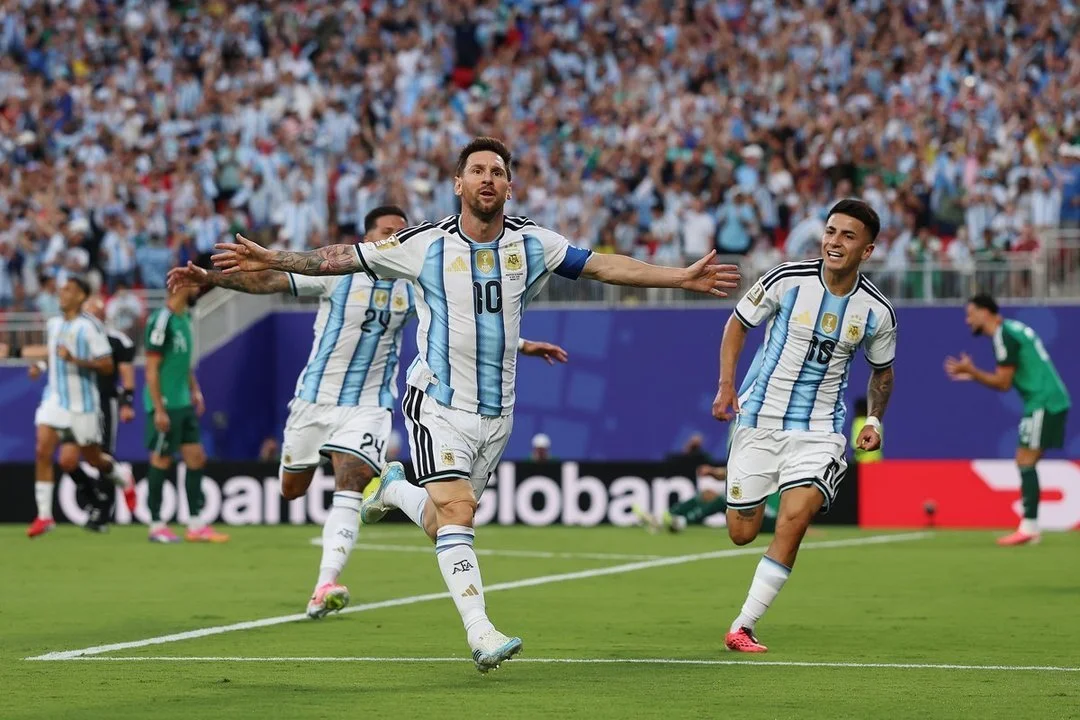
La Albiceleste began its title defense with authority at Arrowhead Stadium in Kansas City. From the opening minutes, Scaloni set up a team that sought possession and territorial control, with Rodrigo De Paul and Enzo Fernández dominating the midfield. In the 17th minute, Lionel Messi received a through ball inside the box, controlled with his right and finished into the far post to open the scoring. The goal sparked the joy of the thousands of Argentine fans who packed the stadium with flags and chants.
Algeria tried to react but found no way through against a solid defense led by Cristian Romero. Scaloni's team managed the lead patiently, without rushing, moving the ball from side to side until it found the spaces. The first half ended with clear Albiceleste dominance, and the team could have extended the lead on at least two more occasions. The side showed the same solidity and patience that characterized it in Qatar 2022, waiting for the right moment to accelerate.
Second half: Messi completes the hat-trick
After the break, Argentina raised the intensity and Scaloni made adjustments to try to extend the lead. In the 60th minute, Messi appeared again: he received at the edge of the box, beat a defender with a cut and placed a shot into the top corner that gave the Algerian keeper no chance. The second goal killed off any intention of a comeback, drew an ovation from the fans and gave the team the calm to manage the final stretch at its own pace.
The hat-trick came in the 76th minute, when Messi completed his perfect night with a third goal that sealed the rout. With those three goals, he equaled Miroslav Klose's 16 World Cup goals as the all-time top scorer in World Cup history. With one more goal, he would become the outright top scorer, a mark he could reach against Austria on June 22. "Dibu" Martínez did not have to make a single dangerous save in the 90 minutes, which speaks to the Albiceleste's defensive level.
Tactical analysis: Scaloni's solidity
Possession and control
Scaloni repeated the formula that gave him the title in Qatar 2022: a compact team that defends as a block and attacks with surgical precision. Enzo Fernández was the engine of the midfield, distributing short and long passes with equal effectiveness. Alongside him, De Paul brought intensity in recovery and quick transitions that fed Messi and Julián Álvarez in attack. The tactical scheme let Argentina control the rhythm of the match without wearing itself out physically, essential in a 48-team tournament where managing effort across up to seven matches can make the difference between winning the title and falling short.
The impenetrable defense
The defensive line was the other big protagonist of the night. Cristian Romero led the center of defense with authority, winning aerial duels and anticipating every Algerian attacking attempt. The full-backs brought balance between marking and attacking overlaps, closing the wide spaces without neglecting the counterattack. Algeria failed to create a single clear chance, and Martínez's goal stayed clean. That defensive solidity will be key in the knockout rounds of the 2026 World Cup bracket, where a single goal against can mean elimination and where concentration over the 90 minutes is non-negotiable.
Argentina's standout players at the 2026 World Cup
Lionel Messi: one goal from history
Lionel Messi, at 39, showed he is still the best player in the world on the big nights. His hat-trick against Algeria was the first of his career at World Cups and put him one goal away from becoming the outright top scorer in tournament history. Messi arrives at this World Cup as defending champion after the Qatar 2022 triumph and two-time Copa América winner (2021 and 2024). This could be his last tournament with the national team, which gives every match an extra historic weight. Every goal he scores brings him closer to the all-time record and feeds the dream of a perfect farewell with a fourth star.
The new generation
Julián Álvarez is the attacking reference that complements Messi. Unlike Qatar, where he alternated with Lautaro Martínez, Álvarez has cemented himself as an undisputed starter thanks to his versatility: he can play as a center forward, second striker or on the wings. Enzo Fernández, world champion at just 21 in 2022, is now the midfield hub. His ability to read the game, distribute and arrive in the box makes him one of the most complete midfielders in the tournament.
The experience of "Dibu" Martínez
"Dibu" Martínez closes the team's backbone from goal. The keeper, hero of the penalty shootouts in Qatar 2022 and in the two Copa América wins, brings security between the posts and a vocal leadership that organizes the whole defense. His ability to read penalties and his personality in pressure moments make him a differential factor when matches are decided in the details.
The depth of the Argentine squad also includes players like Alexis Mac Allister (Liverpool midfielder with Premier League experience), Nicolás González (winger with a scoring threat) and Nahuel Molina (right-back with attacking overlaps). That variety gives Scaloni real options to rotate without losing competitive level across a tournament that can demand up to seven matches in just over a month.
Group J: the rivals and the table
Austria: the duel for top spot
In the other Group J match, Austria beat Jordan 3-1 with goals from Romano Schmid, a Yazan Al Arab own goal and a stoppage-time Marko Arnautovic penalty. Austria is a competitive team not to be underestimated: it boasts stars like Marcel Sabitzer (Borussia Dortmund) and Marko Arnautovic, and arrives at the direct duel with Argentina on June 22 with the same 3 points and plenty of confidence. The result of that match will decide the group lead and, with it, the whole path of both teams through the 2026 World Cup bracket.
Jordan and Algeria
Jordan and Algeria were left without points after matchday one. Both teams have mathematical chances of qualifying as best third-placed teams in the 2026 World Cup bracket, but they will need favorable results and a combination of scores in the two remaining matchdays to do so. For Argentina, the match against Jordan on June 27 in Dallas should be a chance to secure qualification even if the result against Austria is not favorable. In any case, the Albiceleste has its destiny in its own hands: two more wins and first place in the group is guaranteed.
| # | Team | P | W | D | L | GF | GA | GD | Pts |
|---|---|---|---|---|---|---|---|---|---|
| 1 | Argentina | 1 | 1 | 0 | 0 | 3 | 0 | +3 | 3 |
| 2 | Austria | 1 | 1 | 0 | 0 | 3 | 1 | +2 | 3 |
| 3 | Jordan | 1 | 0 | 0 | 1 | 1 | 3 | -2 | 0 |
| 4 | Algeria | 1 | 0 | 0 | 1 | 0 | 3 | -3 | 0 |
The projected path through the 2026 World Cup bracket
In the 48-team format, finishing first gives a more accessible matchup and a side of the 2026 World Cup bracket with fewer powers. Winning the group is a priority to avoid dangerous matchups from the first knockout rounds. Hover over each round to see the details:
vs Austria (Jun 22)
vs Jordan (Jun 27)
ESP 0-0 Cape Verde
URU 1-1 Saudi Arabia


USA lead Group D
Group G open
Colombia lead Group K
Portugal drew with DR Congo
England 4-2 Croatia
Kane brace
78,576 spectators
The fourth star
Round of 32
If Argentina stays first, in the Round of 32 it would clash with the runner-up of Group H, where all four teams have 1 point after matchday 1 draws (Spain 0-0 Cape Verde, Uruguay 1-1 Saudi Arabia). That group remains completely open and any team could finish second. Giving up first place in Group J would significantly complicate the picture: it would mean facing the Group H leader in the Round of 32 (which could be Spain or Uruguay) and the path would fill with obstacles from the first knockout round.
Round of 16, quarterfinals and semifinals
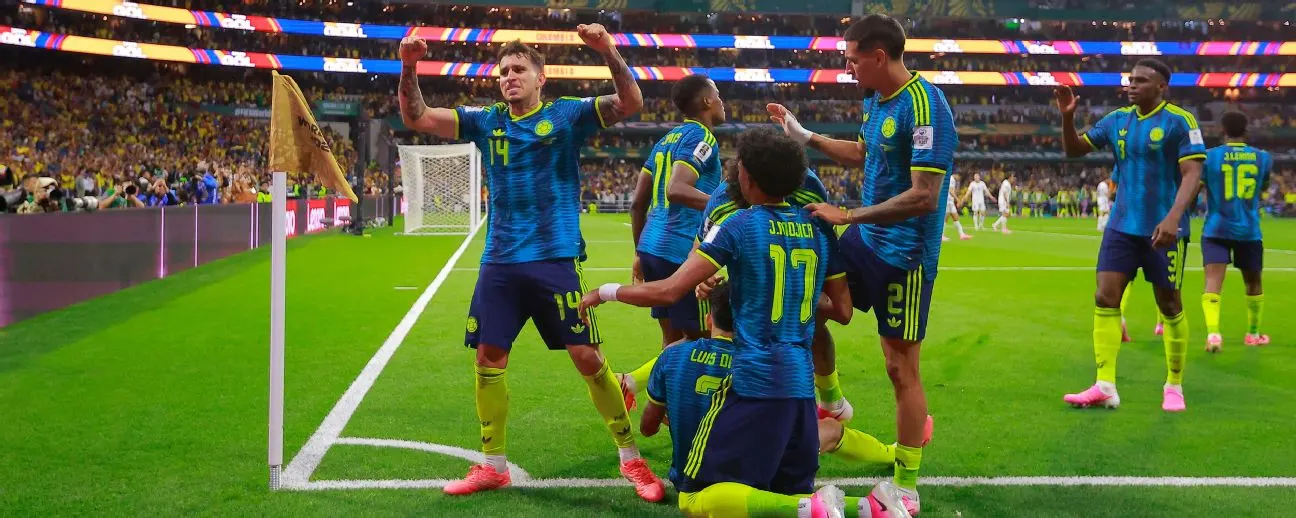
From the quarterfinals, the 2026 World Cup bracket projects Colombia or Portugal as possible rivals. Colombia led its group after thrashing Uzbekistan 3-1, while Portugal only drew 1-1 with DR Congo. The semifinals could feature Brazil or England. A hypothetical Argentina vs. Brazil in the semifinal would be one of the most anticipated matchups of the tournament, a South American classic with decades of World Cup rivalry. Brazil drew 1-1 with Morocco on its debut and has not yet shown its best version, but it remains a rival of enormous pedigree that Argentina would prefer to face as late as possible in the bracket.
| Round | Likely rival | Venue | Approx. date |
|---|---|---|---|
| Groups (2nd and 3rd) | Austria / Jordan | Arlington / Dallas | Jun 22 and 27 |
| Round of 32 | 2nd Group H | Miami | Jul 3 |
| Round of 16 | 2nd D vs 2nd G | Atlanta | Jul 7 |
| Quarterfinals | Portugal / Colombia | Kansas City | Jul 11 |
| Semifinal | Brazil / England | Atlanta | Jul 15 |
| Final | TBD | New York/NJ | Jul 19 |
The World Cup bracket is taking shape
Argentina's side of the draw
The matchday-one results sketched the knockout bracket in Argentina's zone. Colombia thrashed Uzbekistan 3-1 at the Azteca (goals from Muñoz, Luis Díaz and Campaz) and leads Group K, while Portugal only rescued a 1-1 against DR Congo. In Group L, England crushed Croatia 4-2 with a Harry Kane brace. Winning Group J would let the Albiceleste dodge those teams until the quarterfinals or semifinals of the bracket.
The other side: France and Germany
On the other side of the draw wait France (3-1 over Senegal at MetLife) and Germany (7-1 over Curaçao), rivals Argentina would only face in the final on July 19 at MetLife Stadium in New Jersey. The structure of the 2026 World Cup bracket rewards the group winner with a cleaner path to the final, and that is the main motivation to secure top spot against Austria on June 22. If Argentina finishes first, it would avoid any of those powers until the more advanced rounds of the tournament.
Argentina at the World Cups: the road to a fourth star
The golden era (1978-1986)
Argentina has three stars on the crest. The first came in 1978, as host, with a team led by Mario Kempes that beat the Netherlands in the final. The second was at Mexico 1986, Diego Maradona's World Cup: the goal of the century against England, the "Hand of God" and an individual triumph that lifted Argentine football to the top of the world. Those two cups established Argentina as a World Cup power and created a legacy every later generation has tried to match.
The drought years (1990-2018)
After 1986, the national team lived through decades of frustration. It was runner-up at Italy 1990 (loss to Germany) and at Brazil 2014 (defeat to Germany in extra time). Talented generations with Batistuta, Riquelme, Messi, Higuaín and Agüero failed to lift the cup. The Round of 16 elimination at Russia 2018 (4-3 to France, with an Mbappé brace) seemed to close an era and cast doubt on whether Messi would ever win a World Cup. The national team needed a deep renewal, and it found one in an unexpected coach.
Qatar 2022: the triumph
Everything changed under Lionel Scaloni. At Qatar 2022, Argentina lost its opener to Saudi Arabia but recovered to win the tournament with an epic final against France (3-3 in 120 minutes, win on penalties). Messi was named the tournament's Golden Ball for the second time and completed his legacy with the only title that eluded him. The 2021 Copa América (against Brazil) and the 2024 Copa América (against Colombia) cemented this generation as the most successful in Argentine history. Now, in 2026, the goal is clear: a fourth star, something only Brazil (5), Germany (4) and Italy (4) have achieved in football history.
What's next: Austria decides the group
Matchday 2: Austria in Arlington
On Monday June 22 at AT&T Stadium in Arlington, Argentina faces Austria in the duel that will decide the lead of Group J. The Austrians arrive confident after their rout of Jordan, with Sabitzer and Arnautovic as the main stars. It will be a demanding match, the kind that sets the course in a tournament. An Argentine win would secure first place and the most favorable zone of the 2026 World Cup bracket. Giving up the lead complicates everything: it would mean facing the Group H leader in the Round of 32 and the France or Germany zone from the quarterfinals.
Matchday 3: Jordan in Dallas
The group stage closes on Saturday June 27 against Jordan at the Cotton Bowl in Dallas. If Argentina has already secured the lead after beating Austria, Scaloni could manage minutes and give playing time to substitutes with the Round of 32 in mind. Otherwise, the match becomes a decisive matchday where every point counts to define the final position in the group.
Finishing first gives Messi, at 39, the best possible path to a fourth star. Every Scaloni decision in these two matchdays will have a direct impact on Argentina's run through the 2026 World Cup knockout bracket. The debut against Algeria was the first test passed with flying colors; up to six more matches remain for this golden generation to close its cycle in the best possible way.
Follow the path
- Interactive bracket: play with the Albiceleste's scenarios.
- Group J · Argentina national team · Full schedule
- Colombia's path at the 2026 World Cup.
- Today's matches: times, scores and where to watch.
Sources: results verified live; bracket based on FIFA's official draw. Updated: June 18, 2026.
Frequently asked questions
When does Argentina play its next 2026 World Cup match?
Argentina faces Austria on Monday June 22 at AT&T Stadium in Arlington. If it wins, it could secure qualification to the Round of 32 before the final matchday against Jordan (Saturday June 27, Dallas).
How did Argentina do against Algeria at the 2026 World Cup?
Argentina won 3-0 in Kansas City with a Lionel Messi hat-trick (minutes 17, 60 and 76). Messi equaled Miroslav Klose's 16 World Cup goals as the tournament's all-time top scorer.
Who does Argentina play in the Round of 32 of the 2026 World Cup bracket?
If it finishes first in Group J, it would face the Group H runner-up. That group is wide open: Spain drew 0-0 with Cape Verde and Uruguay drew 1-1 with Saudi Arabia, so all four teams have 1 point.
What does the 2026 World Cup bracket look like for Argentina?
In the knockout bracket, if Argentina wins Group J it avoids Colombia (Group K leader) and England (Group L leader) until the quarterfinals or semifinals. A clash with Brazil would only be possible in the semifinal or the MetLife final.
Who are Argentina's standout players at the 2026 World Cup?
Lionel Messi leads the team at 39 and has already equaled Klose's record of 16 World Cup goals. He is joined by Julián Álvarez as an attacking reference, Enzo Fernández in midfield and "Dibu" Martínez in goal.
How many World Cups has Argentina won?
Argentina has won three World Cups: 1978 (at home), 1986 (with Maradona) and 2022 (with Messi in Qatar). In 2026 it seeks a fourth star, something only Brazil (5), Germany (4) and Italy (4) have achieved.
Article by
Luis MoralesJournalist and founder of the blog
Luis Morales is a professional journalist who graduated from Universidad del Externado de Colombia and the founder of this World Cup 2026 blog. He has worked for over three years as a copywriter specialized in football and major sporting events. Every article combines journalistic rigor with verification against official FIFA sources to deliver clear, accurate and useful information for fans.
Journalist and content writer · Universidad del Externado de Colombia · 3+ years
See all articles by Luis Morales →Explore more of the 2026 World Cup